Businesses increasingly depend on external technology talent in order to fill skill gaps, manage workloads, and keep the projects moving. In 2026, this trend is even more visible as companies face rising development costs, faster digital transformation cycles, and a global shortage of specialized IT skills such as AI engineering, cybersecurity, and cloud architecture. At the same time, remote work and distributed teams have made it easier than ever to access global talent.
But bringing outside professionals into your team does not always mean the same thing. Two common approaches, IT staff augmentation and IT outsourcing, give businesses different levels of control, flexibility, and responsibility.
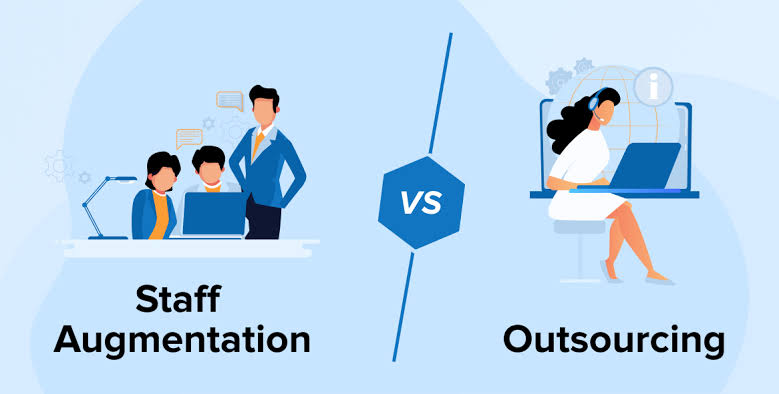
The difference matters when you need to decide how much of the work your internal team should manage. Staff augmentation adds external professionals to your existing team, while outsourcing transfers responsibility for specific projects or functions to an outside provider.
Neither model works best for every situation. Your project requirements, internal capabilities, timeline, budget, and level of control should guide the decision.
This guide compares IT staff augmentation vs. outsourcing, explains how each model works, and shows when each option makes sense for businesses in 2026.
What Is IT Staff Augmentation?
IT staff augmentation allows businesses to bring external technology professionals into their existing teams for a specific period. The added specialists work alongside your employees and follow your processes, tools, and project requirements.
In practice, this model is often used to quickly scale development teams without going through long recruitment cycles. Instead of hiring full-time employees, which can take months, companies can onboard skilled professionals in days or weeks.
For instance, a company might have a strong software development team but they may lack a cybersecurity specialist for an upcoming project. Instead of hiring a permanent employee, the company can bring in an external cybersecurity professional to fill that gap.
Your internal team usually manages the augmented professionals and assigns their day-to-day tasks. This arrangement gives you more control over how the team works while allowing you to scale your technical workforce when needed.
One of the key advantages of staff augmentation is speed. It allows companies to respond quickly and in no time to project demands without any long-term hiring commitments. It also helps to maintain continuity because external professionals integrate directly into your workflows, tools, and communication channels.
Staff augmentation can work particularly well for businesses that already have strong project management capabilities but they need additional expertise or capacity. It is also useful when companies want to retain full control over product direction while temporarily expanding execution capacity.
Related: IT Staff Augmentation Companies
What Is IT Outsourcing?
IT outsourcing refers to hiring an external provider for handling specific technology services, projects, or functions. Instead of adding and stacking individual professionals to your existing team, you give the provider responsibility for delivering agreed-upon outcomes.
Outsourcing providers naturally operate as fully managed teams. They handle recruitment, onboarding, project management, execution, and delivery. This means the client does not need to manage day-to-day operations.
An outsourced provider may manage software development, infrastructure, cybersecurity, technical support, cloud services, or an entire IT function. There are also different outsourcing models, including:
Project-based outsourcing, where a provider delivers a defined project that is set with clear requirements.
Managed services, where a provider continuously manages a function such as IT support or infrastructure.
Dedicated teams, where a provider builds a full team that works exclusively on your projects.
For example, a business might outsource the development of a new mobile application to an IT services company. The provider handles staffing, project management, development, testing, and delivery while the client focuses on its core business activities.
This model suits organizations that want to transfer responsibility for a specific function without building & managing the required team internally. It is especially useful for companies that lack internal technical leadership or want to reduce operational overhead.
Related: IT Managed Services Companies
IT Staff Augmentation vs. Outsourcing: Key Differences
Both models give businesses the access to external IT expertise, but they distribute control and responsibility differently.
Factor | IT Staff Augmentation | IT Outsourcing |
|---|---|---|
Team control | Client manages external professionals | Provider manages the team |
Project ownership | Client usually leads the project | Provider usually manages delivery |
Hiring flexibility | Easy to add or remove specific skills | Provider handles staffing |
Management responsibility | Client manages daily work | Provider manages daily operations |
Best for | Skill gaps and changing workloads | Complete projects or ongoing functions |
Scalability | Scales individual roles or skills | Scales through the provider |
Internal involvement | High | Lower |
Control
Staff augmentation gives your business a greater control over daily tasks, priorities, and workflows. You decide how external professionals contribute to the project and can integrate them into your existing processes. This is especially valuable when product direction is sensitive or requires close alignment with internal stakeholders.
Outsourcing gives the provider increased control over execution. You define the expected outcome while the provider determines how its team completes the work. This leads to reducing your operational involvement but it also limits direct oversight.
Project Responsibility
With staff augmentation, your internal managers usually remain responsible for planning, coordination, and delivery. The external professionals become an extension of your existing team but accountability stays inside your organization.
Outsourcing shifts more responsibility to the service provider. The provider is ought to manage the project, allocate resources, handle risks, and work toward the agreed deliverables. This can really reduce the burden on internal teams.
Flexibility
Staff augmentation offers flexibility when you need a particular skill for a limited period. You can add specialists without committing to permanent employment & remove them when the need ends.
Outsourcing provides flexibility at the service level. You can hand an entire project or function to a provider without recruiting & managing the required employees yourself. This is useful when workload is unpredictable or when scaling quickly is required.
Cost Structure
Staff augmentation generally charges for the professionals or hours that you use. Costs are more transparent at the individual level, but your business still handles project management and coordination internally.
Outsourcing usually follows a project-based, fixed-price, or managed-service pricing structure. The provider has staffing, management, and delivery responsibilities within the agreement. While this can simplify budgeting, on the other hand, it may also include a premium for full-service delivery.
Neither model guarantees lower costs. The right choice really depends on the complexity of the work, internal management capacity & long-term business goals.
When IT Staff Augmentation Makes Sense
Staff augmentation can make sense when your internal team already manages projects effectively but needs additional capacity or specialized skills.
Consider this model when:
Your team has a temporary skills gap.
You need specialists for a specific project.
Your workload changes frequently.
You want direct control over external professionals.
You already have experienced project managers.
You want to extend your team without making permanent hires.
For example, a company preparing to launch a major software update might temporarily add developers, testers, DevOps engineers, or cloud specialists. Once the workload decreases, the company can reduce the augmented team without maintaining permanent positions.
This model is also useful for accelerating delivery timelines. Instead of overloading internal staff, companies can distribute work more efficiently & avoid burnout.
When IT Outsourcing Makes Sense
Outsourcing works well when your business wants another company to take responsibility for a project, service, or ongoing IT function.
Consider outsourcing when:
Your internal team lacks the expertise that is required to manage the work.
You want to transfer project management responsibilities.
You need to launch a complete project without the need to build a team.
You want ongoing support for a specific IT function.
Your internal employees need to focus on core business priorities.
You prefer an external provider to manage staffing & delivery.
For instance, a growing company might outsource its IT help desk instead of creating and managing a dedicated support department. The provider handles staffing, operations, training, and service delivery while the company monitors performance against agreed standards.
Outsourcing is also common in long-term infrastructure management, where stability & continuous monitoring are far more important than direct control.
IT Staff Augmentation vs. Outsourcing: Pros and Cons
Each model comes with advantages and limitations.
IT Staff Augmentation
Pros:
Gives your team direct control over external specialists & how they contribute.
Makes it easier to fill short-term skill gaps without long hiring cycles.
Allows flexible team scaling which is based on project demand.
Integrates external professionals into existing workflows & tools.
Cons:
Your managers remain responsible for daily coordination and oversight.
Your team must provide clear direction and task management.
Poor internal planning can reduce efficiency & impact outcomes.
IT Outsourcing
Pros:
Transfers more management responsibility to the provider, which reduces internal workload.
Gives you access to an established and fully operational team.
Works well for complete projects & ongoing services.
Reduces the need to recruit, train, and manage specialized employees.
Cons:
Gives your business less direct control over daily execution.
Communication can become far more complicated due to external management layers.
Changes in scope may affect timelines or may increase costs.
Success depends heavily on recruiting a reliable provider.
How to Choose the Right Model in 2026
Start on with your internal capabilities. If your team can manage the project but lacks specific skills or additional capacity, then staff augmentation may offer the flexibility that you need.
If you want an external team to take responsibility for delivery, outsourcing may provide a better fit. Consider the level of control you want, the complexity of the work, and how much management responsibility your organization can handle.
A simple decision framework can help to:
1. Define ownership needs — Do you want to manage the project or to delegate it?
2. Assess internal capacity — Can your team handle coordination & delivery?
3. Evaluate skill gaps — Are you missing expertise or full execution capability?
4. Consider timeline pressure — Do you need fast scaling or full project takeover?
5. Review long-term strategy — Is this a temporary need or ongoing function?
Also consider the duration of the requirement. A temporary need for a few specialists may favor augmentation, while a long-term IT function may benefit from outsourcing.
Hybrid Approach: Combining Both Models
In many modern organizations, the choice is not strictly one or the other. A hybrid model is now very much common in 2026.
For instance, a company may outsource infrastructure management while using staff augmentation for software development. This allows them to maintain control over product innovation while delegating operational stability to an external provider.
This blended approach helps businesses to balance control, cost, and scalability more effectively.
Key Takeaways
The choice between IT staff augmentation & outsourcing depends on how your business wants to manage people, projects, and responsibility. Staff augmentation gives you a greater control over external professionals and it works well when you need additional skills or temporary capacity. Outsourcing transfers more responsibility to an external provider and suits businesses that want someone else to manage an entire project or function.
In many cases, a hybrid approach can offer the best balance of flexibility & efficiency. Before choosing either model, assess your team's capabilities, project requirements, timeline & desired level of control. A clear understanding of these factors will help you to choose an approach that supports your goals without adding any unnecessary complexity.